


Esso Watches’ net worth as of 2025 is a whopping $0. The company, producer of silicone health watches sold with promises of negative-ion energy. It was blazed in the news. But it ultimately shut down amid scientific doubt, trademark challenges, and unsustainable operations. Its short trajectory from wellness potential to warning example is a compelling case study on how perception, pitch, and proof must converge to achieve durable value.
Esso Watches’ Net Worth
| Aspect | Details |
| Net Worth (2025) | $0 (company closed and defunct) |
| Creator | Ryan Naylor, digital marketer turned watch entrepreneur |
| Peak Valuation (on TV) | $175,000 (based on Shark Tank ask of $35K for 20% equity) |
| Sales Highlight | Claimed ~$120K in watches sold pre-Shark Tank |
| Core Claim | Negative-ion enhancement for balance and energy—scientifically unverified |
| Fall Factors | Lack of lab backing, trademark dispute (ExxonMobil), returns, operational strain |
Founder Backstory – The Road to Esso
Before joining Esso Watches, Ryan Naylor was a pace-setting trend-visionary entrepreneur. Born and bred in Arizona, Naylor’s life was all passion for fitness, business, and online marketing while growing up. In college, he studied communications and marketing. Which provided him with the expertise to create captivating brand content. Even though he did not have any physical product in his hand.
In the late 2000s, Naylor built LocalWork.com. It is a job-matching site intended to bring employers together with local talent. The site did well, but Ryan had a vision for something with quicker growth prospects as a consumer product. His curiosity led him into the health and wellness category, where he discovered the global buzz about negative-ion technology. From pendants to bracelets, something to balance energy or generate wellness was popping up everywhere.
Naylor spotted an opening: too many wearable ion products were clumsy, unfashionable, or expensive. What he desired was a sleek, silicone watch that was both a fashion accessory and a health benefit-marketed to fitness buffs, young professionals, and style obsessed consumers.
Concept to Creation – Creating the Prototypes
With about $10,000 in seed money, half borrowed, half saved, Naylor commissioned designs for a light silicone watch. Simple in face design, the large, sporty color options included neon green, hot pink, and matte black. Encased in the silicone, Naylor asserted, were minerals infused with negative ions.
The concept was simple: wear the watch daily, and the negative ions would allegedly improve balance, relax stress, and boost energy. The science was questionable, but the marketing terrain was firm, trendy wellness.
He had a first production run by mid-2011. He made early sales through means of fitness expos, local boutiques, and online-based sales through a simple Shopify website. Sales flowed in steadily, powered by his web-based marketing skills.
The Shark Tank Pitch – Moment in the Limelight
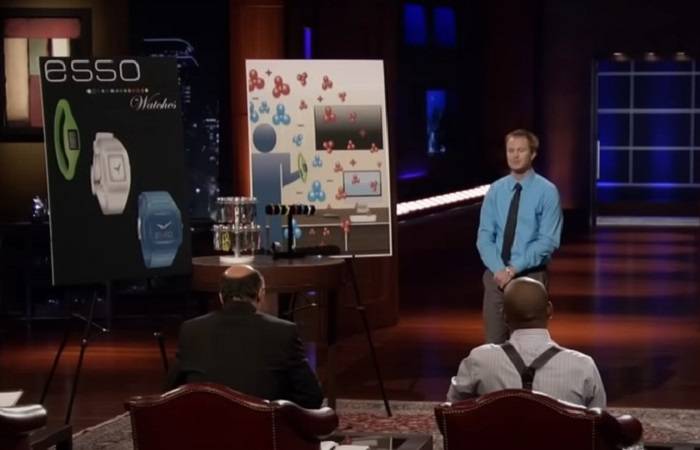
Ryan Naylor strode into the Shark Tank in 2012 confidently. He was wearing an Esso Watch on his wrist, shaking the Sharks’ hands, and rattling off a well-practiced elevator pitch: $35,000 for 20% of the equity, valuing the company at $175,000. He focused on the wellness benefits and sales numbers, over $120,000 in revenue on a $10,000 investment.
Then came the “balance test” demo
Lori Greiner balanced on one leg without the watch, unsteady.
She balanced on one leg with the watch, appearing steadier.
The Sharks were interested… briefly.
The questions came quickly:
- Mark Cuban required proof of ion emission and measurable impact on health.
- Daymond John asked him about competition—how Esso was different from other silicone watches.
- Kevin O’Leary simply asked, “Is this a scam?”
- Robert Herjavec, while courteous, didn’t see long-term success.
By the last offer, five Sharks rejected them. Hold-ups were no scientific evidence and risk of promoting something with untested health benefits.
Surge in Sales and Stress
Despite rejection, national TV exposure was a double-edged sword. Their website was overwhelmed with orders overnight, hundreds in a single week alone. Sales doubled from months prior to airing.
However, the surge revealed weaknesses:
- Demand exceeded the modest supply chain, and delays resulted.
- Customers began requesting refunds following questionable reviews of negative-ion benefits.
- Refunds and chargebacks eroded profit margins.
- Naylor covered costs with personal funds and small loans rather than Shark investment, a gamble that soon became unsustainable.
Net Worth Growth Over Time
| Era / Year | Milestones | Estimated Net Worth |
| Pre-Shark Tank | Startup phase, ~$120K sales on $10K investment | ~$70K – $100K |
| Shark Tank Moment | Valuation at $175K based on pitch | $175K (paper valuation) |
| Post-Shark Tank Spike | Temporary sales lift, operational push | $50K – $120K |
| Legal Troubles & Return Pressure | Trademark lawsuit + high returns erode margin | $0 (by closure) |
Marketing vs. Evidence
Negative ions certainly exist but their physiological effect in wearable products is a matter of scientific debate. Independent labs tested similar products and found infinitesimal amounts of emissions from minerals embedded in silicone. The health benefits, so prevalent in most of the alternative health community, could not be substantiated in a mainstream consumer and regulator-acceptable format.
This became a PR nightmare. Health bloggers and skeptics were posting negative blog posts. Customer trust broke down, and what was a hot product became a flash in the pan.
Trademark Trouble – The ExxonMobil War
Then, in 2013, another issue cropped up, this time from a Fortune 500 giant. ExxonMobil holds the global trademark for “Esso,” one of its oldest gas brands. Although “Esso” was a form of Italian slang for “that’s cool,” the legal clout of ExxonMobil was not to be fought.
A cease and desist letter was sent by requesting that the name be dropped and the company shut down. Rebranding would have been too expensive. It has been too long, and already sales are crashing. Naylor chose to pack up instead of battling on.
What If Esso Watches Had Lived?
Had Naylor gained scientific acceptance or accepted being a purely fashion-oriented watch company, Esso might have been an acceptably lifestyle-oriented brand. Other options:
Dropping health claims and adopting the strategy of being fun, cheap, sports watch fashion.
- Partnering with fitness and streetwear influencers.
- Tapping into accessories or apparel.
- Rebranding earlier to avoid legal problems.
These changes could have extended the life of the brand and established a loyal niche following.
Reception by Consumers – From Buzz to Bust
Early customers appreciated the bright color schemes and lower prices, and they presented them as gifts to their peers. Some took oaths on supposed health benefits, claiming they felt increased energy or concentration. But as skepticism increased, so did grievances. By late 2013, sites such as Reddit and watch collector forums were questioning the validity of the product.
The shift in consumer sentiment, from skepticism to skepticism, was instant. For a small business with lean pockets, combating that was more or less an exercise in futility.
Post-Closure – The Cult Following
Esso Watches are a rare eBay purchase today, sometimes sold as novelty collector’s items. A few health enthusiasts still jump to their defense, but most consumers purchase them as a rare piece of Shark Tank history. The company is now in a “failed startup” legend status and is controversial among entrepreneurs as a warning tale of overnight success and overnight failure.
Legacy of the Founder
Ryan Naylor wiser and more cautious emerged from the Esso debacle. Later recruitment technology business ventures he pursued avoided unsubstantiated claims and legal battles. He is now open in interviews about the Esso affair, framing it as a cautionary tale of due diligence, proof of concept, and business persistence.
Entrepreneurial Lessons for Future Entrepreneurs
The tale of Esso Watches is not a cautionary tale, believe me, it’s a guidebook on how to do things differently. Upstart entrepreneurs can take away that product-market fit does not come from flash appeal, but from a backbone of trust, legality, and operational preparedness.
Promotion and hype can win your attention, but only for as long as the product performs as advertised. A Shark Tank appearance can be a catapult, but not in lieu of having good branding, replicable supply chains, and a value proposition that can survive due diligence. In the end, the people who make it are those who utilize every flashy opportunity as a stepping stone. But not in lieu of building an enterprise that will endure.
FAQs
What was the all-time high valuation of Esso Watches?
About $175,000 at the time it was on Shark Tank.
Why did it fail?
Mix of lack of scientific evidence, supply chain stress, low profit margins, and a trademark lawsuit.
Do Esso Watches still exist?
Not from the company, but occasionally on secondary sites.
Did Ryan Naylor recover from the failure?
Yes, he focused on green tech firms in the recruitment sector.
What is the largest lesson from Esso’s experience?
Credibility and legal protection are as important as promotion and sales.
Last Words
From $120,000 in initial sales to $0 net value, Esso Watches’s fall spells one thing: hype without substance cannot back a company. It also speaks to the creation of even such a failure into informed future entrepreneurship. The watch is history now, but its saga is a cautionary case study for anyone considering launching a business off the back of hype alone.